
See Also: How do I edit my Faculty Profile page?
A power sentence describes the faculty member’s areas of focus and/or most noteworthy accomplishments in 170 characters or fewer. All faculty, including Associates, can provide a power sentence by coordinating with their respective Communications Associate.
Power sentences can be edited in Drupal, along with many other items. Simply edit the field in Drupal like any other content.
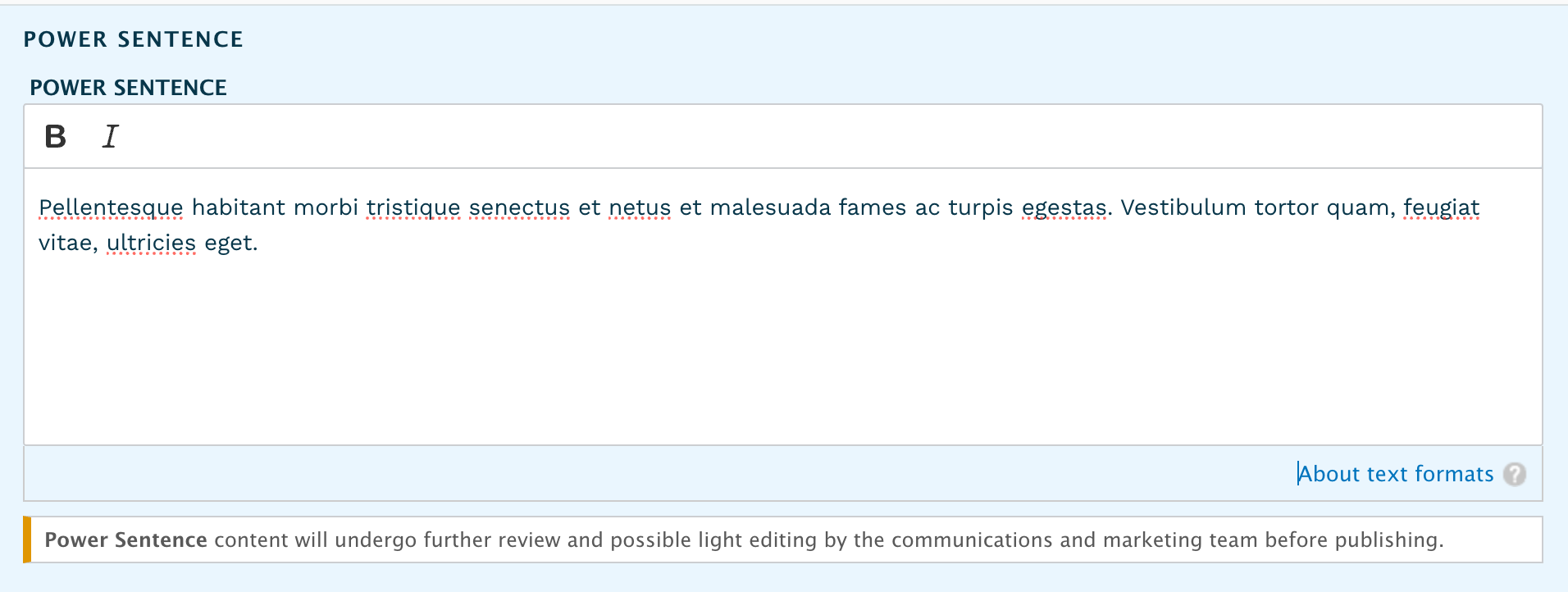
Note on editorial review: Power Sentence edits go through an additional review by the editorial and marketing team before publishing. Your submission may be lightly edited for style, clarity, or consistency with school guidelines.

If major revisions are needed, someone will reach out to you before updating.
Tips for creating an effective Power Sentence
Faculty power sentences are used throughout the PublicHealth.JHU.edu when we display highly esteemed faculty and Department pages on our website. For this ask faculty to provide a succinct sentence summarizing the focus of their work and/or their most noteworthy accomplishments. Please phrase these sentences to begin with your name and to be understood by a non-academic, non-scientific audience. Once submitted, our team may offer suggested edits for refinement. Please include your work email above so we can reach out with any questions or proposed updates.
The power sentences should be approximately 30 words or 170 characters, including spaces.
Please include advanced degrees, but only include dates for Bloomberg School degrees (not for SOM, SON, JHU, etc or other institutions).
Some examples:
- Keshia Pollack Porter, PhD ’06, MPH, uses research to advance policies that promote health equity, especially where people live, work, play, and travel.
- Mary Fox, PhD '01, MPH, is working to develop and refine cumulative risk assessments that consider how epidemiological, toxicological, and environmental sciences together affect the public's health.
- Cassandra Crifasi, PhD '14, MPH, researches injury epidemiology and prevention, gun violence and policy, attitudes and behaviors of gun owners, and underground gun markets.
- Peter Agre, MD '74, received the Nobel Prize in Chemistry in 2003 for his discovery of aquaporin water channels. He is currently leads the School’s efforts to eradicate malaria.
- Monica Mugnier, PhD, is a parasitologist who studies parasites called African trypanosomes that are responsible for a devastating human disease affecting sub-Saharan Africa.
We very much appreciate your collaboration on this process.