
See Also: How do I edit my Faculty Profile page?
A power sentence describes a faculty member’s areas of focus and/or most noteworthy accomplishments.
Power sentences can be edited in Drupal, along with many other items. Simply edit the field in Drupal like any other content.
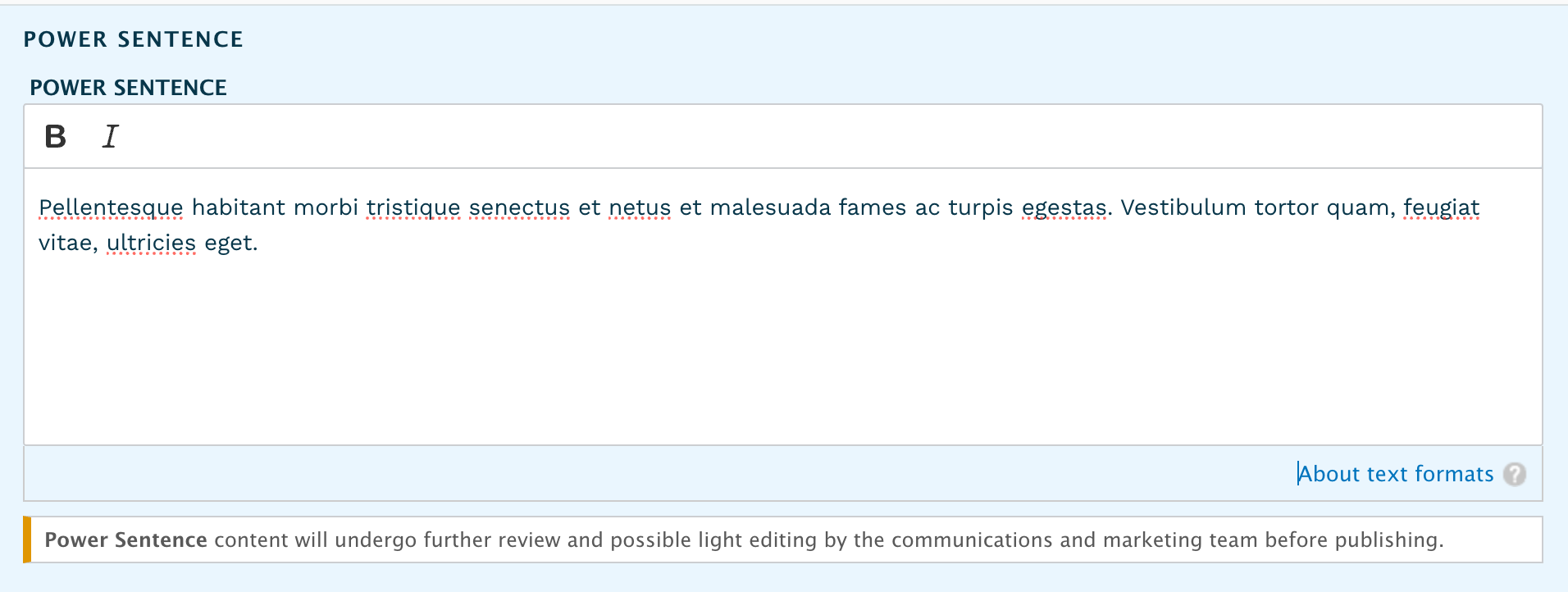
Note on editorial review: Power Sentence edits go through an additional review by the editorial and marketing team before publishing. We may lightly edit your submission for style, clarity, or consistency with school guidelines.

If major revisions are needed, someone will reach out to you before updating.
Tips for creating an effective Power Sentence
Faculty power sentences appear throughout PublicHealth.JHU.edu. For this, we ask faculty to provide a succinct sentence summarizing the focus of their work and/or their most noteworthy accomplishments. After you submit them, our editorial team may offer suggested edits for refinement.
- Please phrase these sentences to begin with your name and write them for a non-academic, non-scientific audience.
- Power sentences should ideally be about 30 words or between 170-200 characters, including spaces.
This may not always be practical, but shorter and more concise is always better, though not at the cost of losing truly valuable information. - Power sentences should be written in the third person.
- Pay particular attention to the Order of degrees and Alumni, Graduation Years Of sections.
For instance, include advanced degrees, but include dates only for Bloomberg School degrees (not for SOM, SON, JHU, etc., or other institutions). - Please reference the BSPH Editorial Style Guide when drafting your power sentence.
Some examples:
- Keshia Pollack Porter, PhD ’06, MPH, uses research to advance policies that promote health equity, especially where people live, work, play, and travel.
- Mary Fox, PhD '01, MPH, is working to develop and refine cumulative risk assessments that consider how epidemiological, toxicological, and environmental sciences together affect the public's health.
- Cassandra Crifasi, PhD '14, MPH, researches injury epidemiology and prevention, gun violence and policy, attitudes and behaviors of gun owners, and underground gun markets.
- Peter Agre, MD '74, emeritus leader of the Johns Hopkins Malaria Research Institute, is the 2003 Nobel Laureate in Chemistry for his discovery of aquaporin proteins.
- Monica Mugnier, PhD, is a parasitologist who studies parasites called African trypanosomes that are responsible for a devastating human disease affecting sub-Saharan Africa.
We greatly appreciate your collaboration in this.